
The ROI question
Does this actually make money?
The question every CFO is actually asking
Most AI and automation does one thing: it cuts cost and makes people more efficient. That is real, and it matters. But cost savings have a floor. You can only take so much time and labor out of a process, and once it is gone, the return stops. The honest truth is that most projects stop there, because they automate a task instead of rebuilding the system the task lives in. So the fair question a CEO or CFO should ask is not “will this make us faster.” It is “will this make or protect money, and can you prove it.” That is the question we build to answer.
Three layers of value, and where the money is
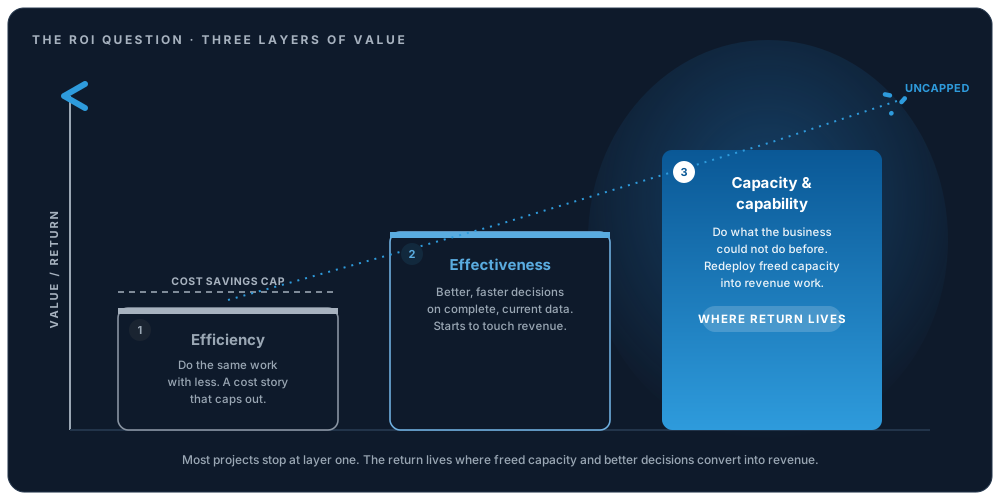
Efficiency is the first layer. Do the same work with less time and labor. It is a cost story and it caps out.
Effectiveness is the second. The same people make better and faster decisions because the data in front of them is complete, current, and trustworthy. This starts to touch revenue, because decisions have dollar consequences.
Capacity and capability is the third, and it is where real return lives. The system either does something the business could not do before, or it frees capacity that gets redeployed into work that generates revenue. Most projects never reach this layer. Reaching it is the point of building from the data layer up rather than bolting automation onto a broken process.
Where we have seen it generate revenue, not just save cost
This is not theory. Several of the systems we have built sit on the revenue side of the ledger, not the cost side.
A field marketing, pop up, and retail sales automation that does not just reduce manual work but drives and captures sales activity that converts to revenue.
A processing and manufacturing CRM built to capture more third party and white label leads for a vertically integrated operator, feeding a pipeline that did not exist in a structured form before. In its first 60 days live, it contributed to a 16% increase in third party processing clients.
A sponsorship sales operating system, in real use by a sports league and its franchises, that sources, scores, and works prospects so the revenue team pursues more and better opportunities. It generated hundreds of pre vetted, source cited leads and fed a pipeline that converted into signed sponsorships.
In each case the mechanism is the same, and it is the one a finance leader cares about: the system adds to the top of the funnel or the top line, it does not only trim the bottom. The specific dollar impact belongs to each client and we will speak to it directly with you under the right terms. What we will state openly is the mechanism, because the mechanism is what tells you whether the return is real.
Why governance is the part that lets you prove it
You cannot claim value you cannot measure. Cost savings are easy to assert and hard to bank. Revenue impact is only credible when you can trace it, which requires one source of truth and a governed data layer underneath the automation. That is why the governance work is not bureaucracy. It is the thing that turns “we think this helped” into a number you can stand behind. Building it in from the start is the difference between a story and a proof.
The bottom line
Efficiency is table stakes and we deliver it. But if the only case for a system is that it cuts cost, it was scoped too small. The systems worth building add capacity and capability that the business turns into revenue, and they are built so that impact can actually be measured. That is the standard we hold, and it is the question we want you to hold us to.
Hold us to it